AI STRATEGY · ARCHITECTURE · COST CONTROL · NEW JERSEY
Most AI advice is written by people who have never shipped any.
I run AI systems in production — a live integration server on Cloudflare Workers, a custom training platform, automated call intake, dashboards that pull real ad and revenue data. That work is where the advice comes from. I have paid for the wrong architecture, hit the vendor limitation nobody documents, and killed a system of my own that was quietly burning money doing work a script should have done. Consulting is me handing you those answers before you buy them yourself.
The first honest answer is usually “not that.”
A useful AI consultant tells you which half of your idea is worth building and which half is a demo that will not survive contact with real customers. Most of the value in these engagements is in what you decide not to spend on.
Built for: owners and operators being pitched AI by vendors, staff, or their own instincts — and anyone who wants a straight technical read before committing budget to a build.
WHAT THIS ACTUALLY IS
Decisions, not decks.
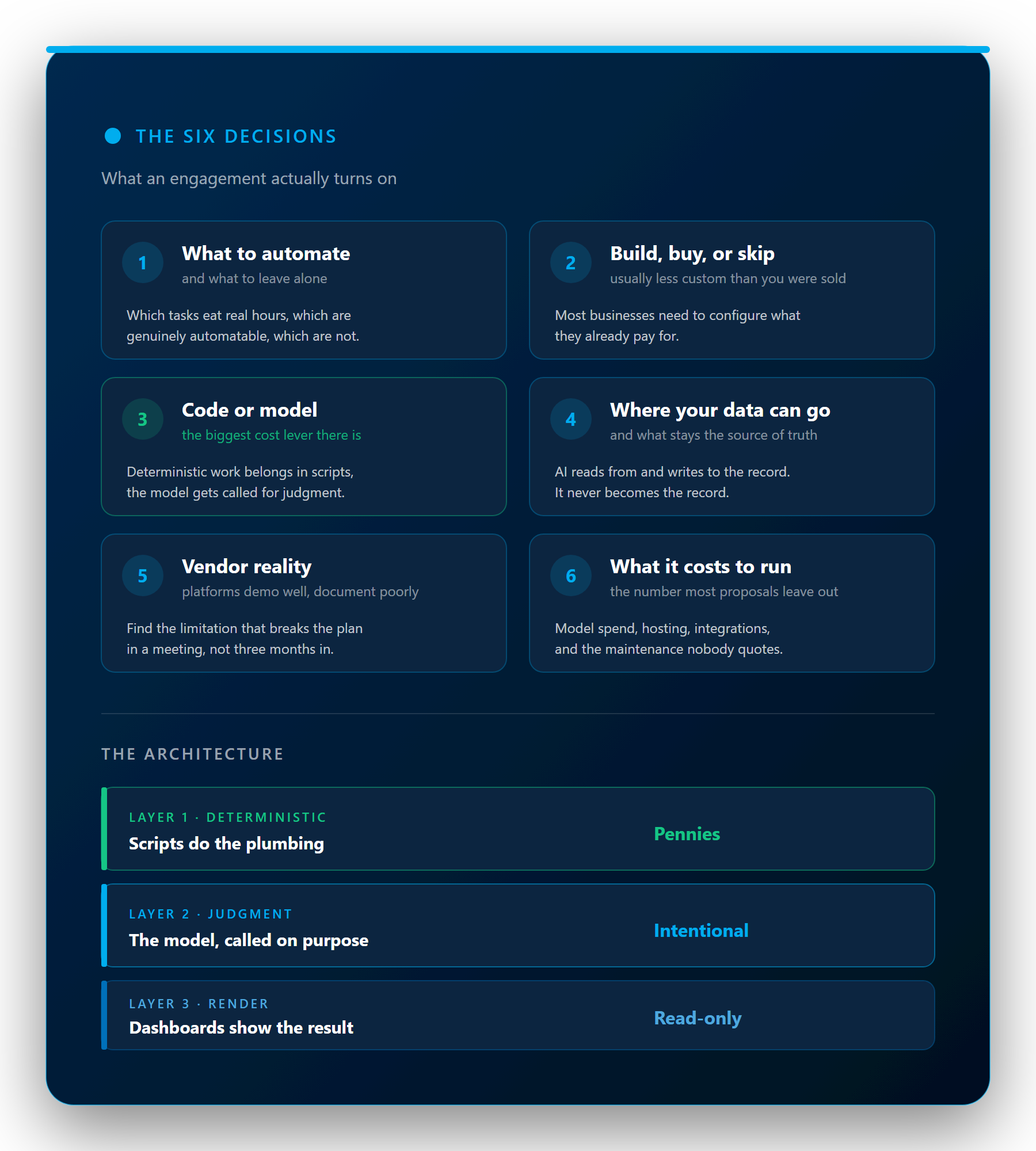
AI consulting has become a category full of slideware: maturity models, readiness scores, roadmaps that end exactly where the hard part begins. This is the opposite. We work through the specific decisions that determine whether an AI project pays for itself — what to automate, what to leave alone, what to build versus buy, which model for which job, where your data can and cannot go, and what the thing will actually cost to run once it is live.
The rule that saves the most money
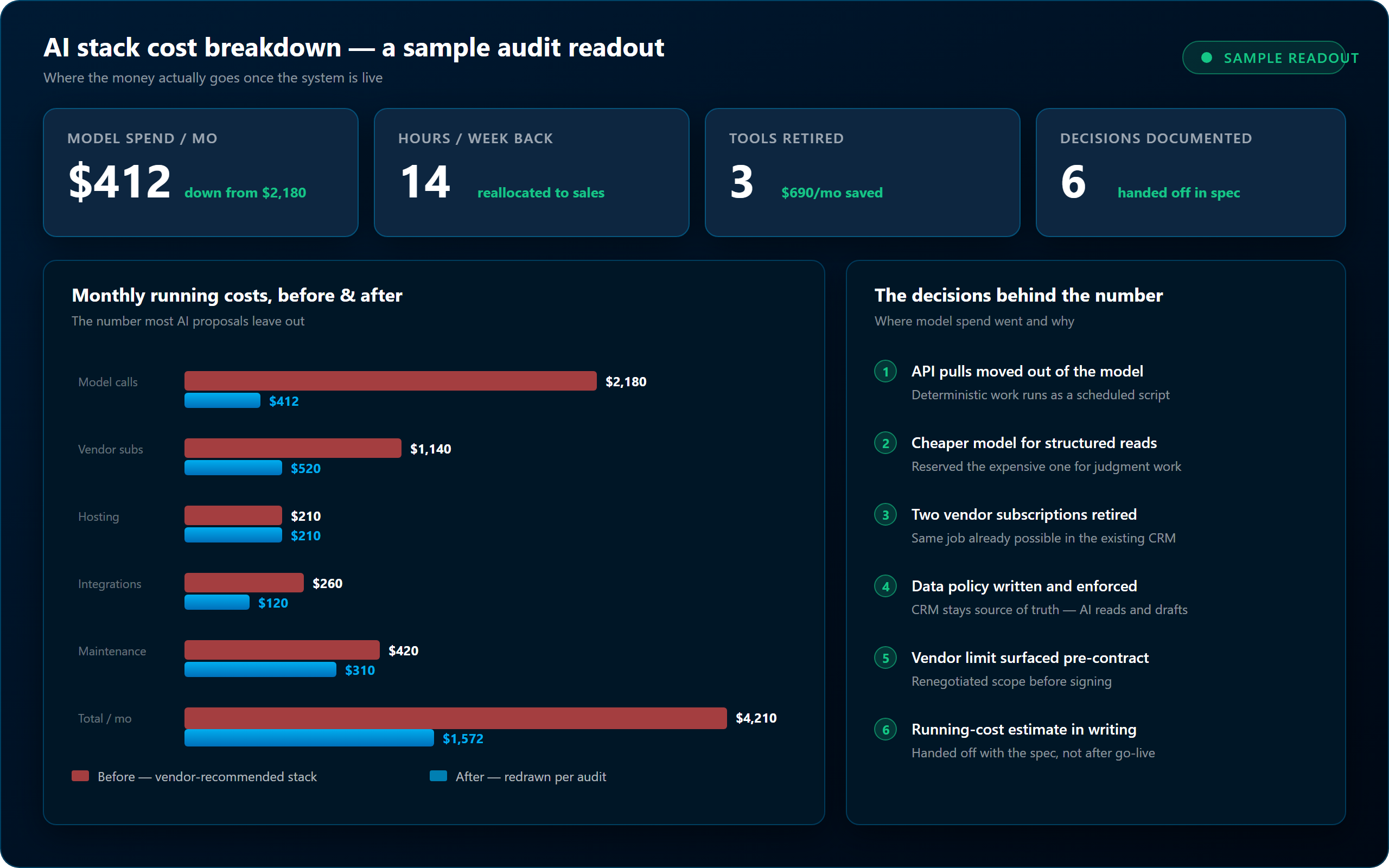
If a script can do it, a script should do it: API pulls, parsing, file operations, scheduled jobs. These are deterministic. Running them through a language model is how AI budgets quietly disappear.
Call the model where judgment is required: synthesis, drafting, classification, qualification — work that genuinely needs reasoning over the result. Then the spend is intentional instead of incidental.
I learned this by getting it wrong: I retired the first version of my own automation layer because it was burning model credits on work that was fundamentally an API call and an if-statement. Redrawing that line is usually the single biggest cost lever in an AI stack.
What we work through.
Opportunity Audit
We start with your actual week, not the technology. Which tasks eat real hours, which of those are genuinely automatable, and which are people-shaped work that will get worse if you automate it. You get a ranked list with honest effort and cost estimates — including the ones I would skip.
Architecture & Stack
Build, buy, or wire together what you already pay for. Where the data lives, what talks to what, and which pieces will still make sense in a year. Most small businesses need far less custom software than they are being sold — and occasionally need one real build that nothing off the shelf will do.
Cost Control & Model Selection
Which work belongs in code and which needs a model, and then which model — the expensive one for hard reasoning, a cheaper one for structured interpretation of numbers you already aggregated. This is where AI projects either stay affordable or quietly become a subscription you resent.
Data, Privacy & Source of Truth
What AI is allowed to read, what it must never be given, and which system stays the authority when they disagree. The rule I hold to in my own stack: AI reads from and writes to the record — it never becomes the record. Plus the practical version for your staff: what can and cannot be pasted into a public chatbot.
Vendor Reality & Build Oversight
Platforms demo well and document poorly. I have burned real hours discovering that a major CRM does not expose its own AI call transcripts through its API or its webhooks — the data existed only in a notification email, and the capture pipeline had to be rebuilt around that. I read the vendor claims, find the limits before you commit, write the spec, and keep a build honest.
Ongoing Advisory
The tools change monthly and most of the change is noise. A standing advisory relationship means someone tells you which developments actually affect your business, reviews what you are about to sign, and is available when a decision needs a second opinion before it becomes expensive.
WHERE THE ADVICE COMES FROM
I consult on this because I run it.
The systems behind this advice are mine and they are live: an integration server running on Cloudflare Workers that gives my AI tools controlled access to my own operations data, a custom training platform built and hosted for a client, live dashboards pulling real ad spend and revenue, and a call-intake pipeline hardened until nothing gets dropped. I have also built autonomous scheduled jobs that pull ad data, aggregate it in code, and use a model only for the interpretation — the pattern I will almost certainly recommend to you, because it is the one that stays affordable.
What you get
A ranked opportunity list: what to automate first, what to leave alone, with real effort and cost estimates against your actual workflows.
An architecture recommendation: build, buy, or configure — written plainly enough to hand to a vendor or a developer.
A written data policy: what AI may read, what it may never touch, and which system remains the source of truth.
A running-cost estimate: what the thing costs per month once live, not just to build — the number most proposals leave out.
WHAT IT COSTS
Published, like everything else here.
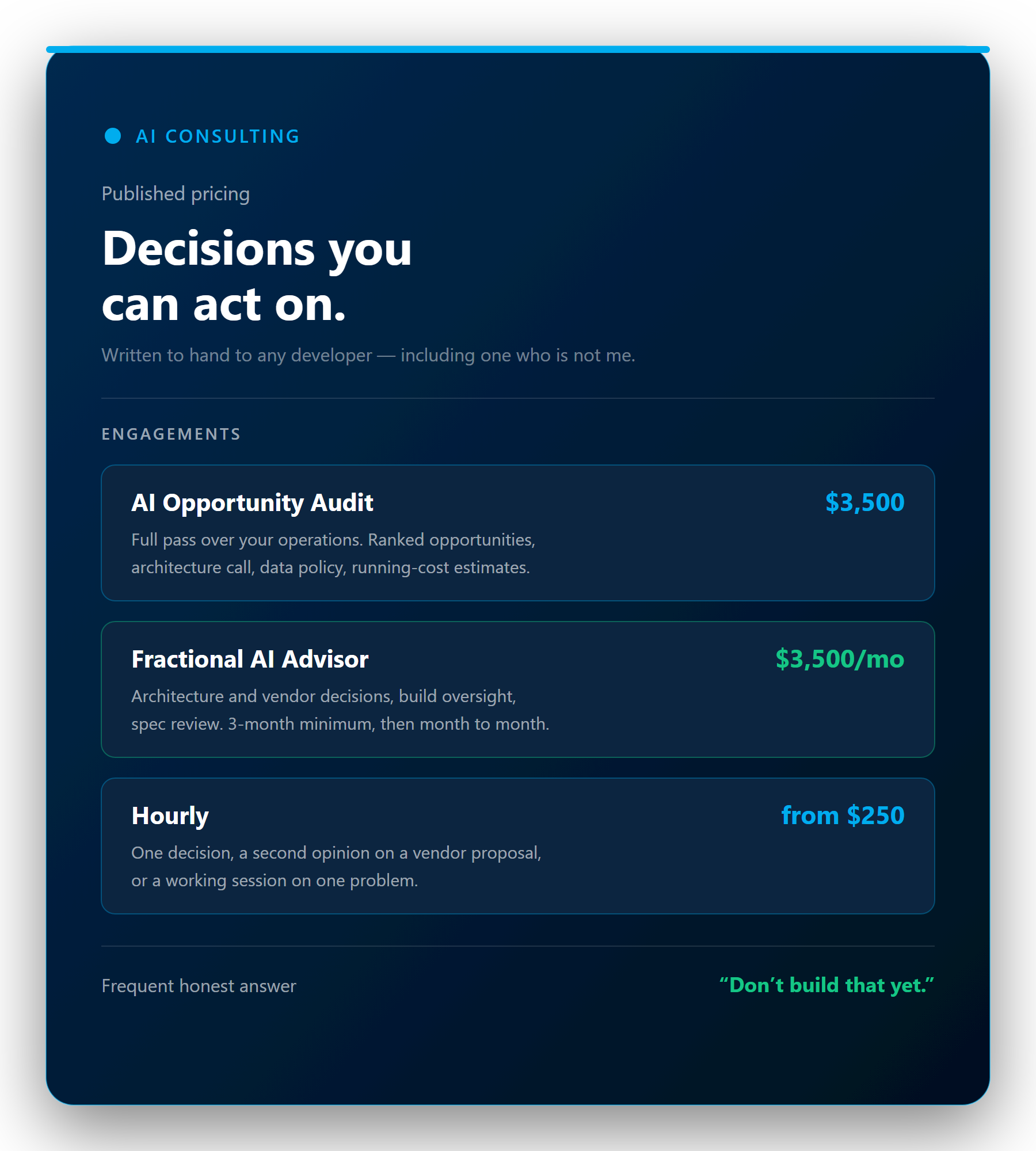
AI Opportunity Audit — $3,500
A full pass over your operations: ranked automation opportunities, an architecture recommendation, a written data policy, and running-cost estimates. Delivered as a document you own and can hand to any developer — including one who is not me.
Fractional AI Advisor — $3,500/mo
A standing seat at the table: architecture and vendor decisions, build oversight, spec review, and someone to call before you sign something. 3-month minimum, then month to month.
Hourly — from $250
For a single decision, a second opinion on a vendor proposal, or a working session on one specific problem.
HOW AN ENGAGEMENT RUNS
Four steps, no theater.
1. Map the week
Where the hours actually go, what your systems are, and what you are already paying for and underusing.
2. Draw the line
What gets automated with code, what genuinely needs a model, and what should stay human. This is the meeting that saves the money.
3. Decide build, buy, or skip
With running costs attached to each option, not just build costs — and an honest read on what your team can realistically maintain.
4. Write it down
A spec and a data policy in plain language, yours to keep and hand to whoever builds it.
Questions people ask first
Will you just tell me to hire you to build it?
No, and the deliverable is deliberately built so you do not have to. The audit is written to be handed to any developer. Plenty of engagements end with “configure what you already own,” or “this is not worth building yet.” If a build genuinely makes sense I will say so, and you are still free to take the spec elsewhere.
We are a small business. Is this overkill?
Usually the opposite — small businesses are the ones most likely to be sold a platform they do not need. An hour or an audit is cheap next to a year of a subscription that never got used, or a custom build that solved the wrong problem.
What will it actually cost to run?
That is the question most AI proposals avoid, so it is a deliverable here. Model costs, hosting, integrations, and the maintenance nobody quotes. Frequently the honest answer changes the decision.
Do you work with the tools we already have?
Almost always. Most businesses are running a fraction of what their existing CRM, phone system, and subscriptions can already do. Wiring those together properly beats adding another platform more often than vendors would like to admit.
Can you talk to our developer or vendor?
Yes, and it is often the highest-value part. I read the proposal, ask the questions that surface the limitations early, and translate in both directions so nobody is guessing what was agreed.
What if we decide to build it with you?
Then see AI Solutions for builds, or AI Training if the answer is that your team mostly needs to learn the tools you already pay for.
Get a straight answer before you spend.
Tell me what you are considering, what you have been pitched, or just where the hours are going. You will get an honest read on whether AI is the answer, what it would take, and what it would cost to run — including when the answer is that you are fine as you are.